

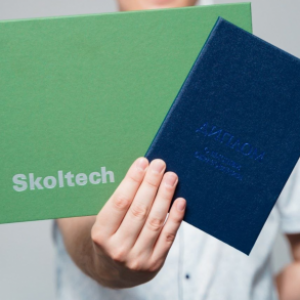
A master's program is an excellent opportunity to deepen one's scientific knowledge and engage in new projects. Students at Samara University have this opportunity thanks to a joint program with the Skolkovo Institute of Science and Technology (Skoltech).
Vladislav Zhuravkov graduated with a bachelor's degree in Electronics and Nanoengineering from the Institute of IT and Cybernetics. When it was time to apply for a master's program, Vladimir Pavelev, Head of the Department of Nanoengineering and Doctor of Physical and Mathematical Sciences, told him about the joint master's program "Photonics and Quantum Materials" with Skoltech, in the field of Applied Mathematics and Physics.
"I immediately saw this as a chance for professional growth and to try myself in a new environment," Vladislav recalls. "Vladimir Sergeyevich explained the details, helped with the paperwork, and supported me throughout the process."
The entrance exams for the master's program were held at Samara University: a list of questions was published on the website, allowing for thorough preparation. At Skoltech, there was an online interview in English, where applicants had to talk about themselves, their scientific interests, and their bachelor's thesis. Vladislav spent his first year studying at Samara University, and his second year at Skoltech, where his academic supervisor became Vladimir Drachev, Head of the Center for Engineering Physics.
The educational process at Skoltech begins with the "Innovation Workshop" – a project-intensive course lasting about a month. Students are divided into teams to develop a pre-commercial project, which they then present to an evaluation committee. The goal is to demonstrate one's skills and show how they can be applied to create innovative solutions. All coursework is conducted in English.
"The first month was tough, but we worked as a team, and everyone helped each other. We had a student from India on our team. Gradually, I started to understand more, and the international students noted that for someone who had just started speaking English, I was doing quite well," Vladislav shares.
His team developed a robot for inspecting the interior of ventilation ducts. The device allows for the detection of blockages and breakdowns from the inside: technicians place the robot at a convenient access point, it travels through the duct, inspects it, and identifies the location of the fault. As a result, there is no need to dismantle the entire ventilation system; it is enough to access the specific problem area and carry out repairs.
"We built the robot from ready-made parts; the kit included motors and metal bars. We additionally purchased an ESP32 module (a microcontroller with Wi-Fi and a camera) and integrated it with an Arduino platform, which handled motion control. We set up control via a web interface: you could open a page in a browser on a phone or a computer. We tested it right at the institute; the technicians allocated a section and opened up the ventilation, so we drove it through and checked everything," Vladislav explains.
The team consisted of five people: two programmers, two members handling the commercial aspects, and Vladislav, who assisted with assembly and software issues.
After the Innovation Workshop, the core major studies began. The educational process at Skoltech is structured differently than at Samara University: instead of semesters, there are terms, similar to school quarters. Every two months, students choose the courses they want to study. Some credits had already been completed during the first year at Samara University, leaving about twenty courses. In the first term, Vladislav chose "Fundamentals of Photonics" to delve deeper into the subject. Later, he took "Solid State Physics" and "Integrated Silicon Photonics."
"These subjects were directly related to my future master's thesis, so I chose them deliberately," he explains.
Vladislav's thesis topic is "Template Synthesis and Optical Properties of Dendritic Nanostructures." Dendrites are nanostructures with a tree-like shape, resembling branches with sharp needles at the ends. Due to their shape, they enhance the local electromagnetic field at these needle-like tips, which allows for the detection of low concentrations of various substances using Raman scattering. In the experimental part, the Rhodamine 6G dye was used—an aqueous solution with a concentration ranging from 10⁻⁸ to 10⁻⁹ mol/L. The dendritic nanostructures were formed on a flat 2x2 cm substrate. A drop of the solution was placed on it; as it dried, the molecules of the substance deposited on the surface. Then, spectra were recorded using a Raman spectrometer to identify the substance.
"The uniqueness lies in how we obtained these structures. We used a membrane with nanoscale pores, electrochemically deposited silver from an electrolyte, and by adjusting the current parameters, achieved a branched, tree-like structure. No one had used this method before. The technology is simple and reproducible; it doesn't require complex equipment or materials." In practice, this can be applied in medicine for virus detection, as well as in forensics. Meanwhile, the spectrometers for recording spectra already exist and work well; for example, Skoltech has a spectrometer worth about 150 million rubles. The goal of the work is to make the process of molecular research simpler and more accessible," Vladislav explains.
According to the graduate, the fundamental training at Samara University significantly helped him at Skoltech.
"I already had a solid foundational base, which greatly facilitated my studies. We covered some topics in Samara before they were even introduced at Skoltech. I already knew what was being discussed and could delve deeper into the details. The connection between the programs turned out to be even closer than I expected," Vladislav notes.
After completing his master's degree, Vladislav stayed on to work at Skoltech; he is currently a research intern in the laboratory. His supervisor, Vladimir Drachev, offered him this opportunity.
"It was unexpected and very pleasant. For me, it is a great opportunity to continue doing what I love, surrounded by passionate people," Vladislav says.
Currently, he is awaiting the results of his application to the Skoltech Ph.D. program.
The Double Degree program opens up a real opportunity for students to test their skills at a leading research center, work in an international team, participate in applied projects, and find their path in science. Meanwhile, the solid foundation laid at Samara University serves as a reliable springboard for future endeavors.
