

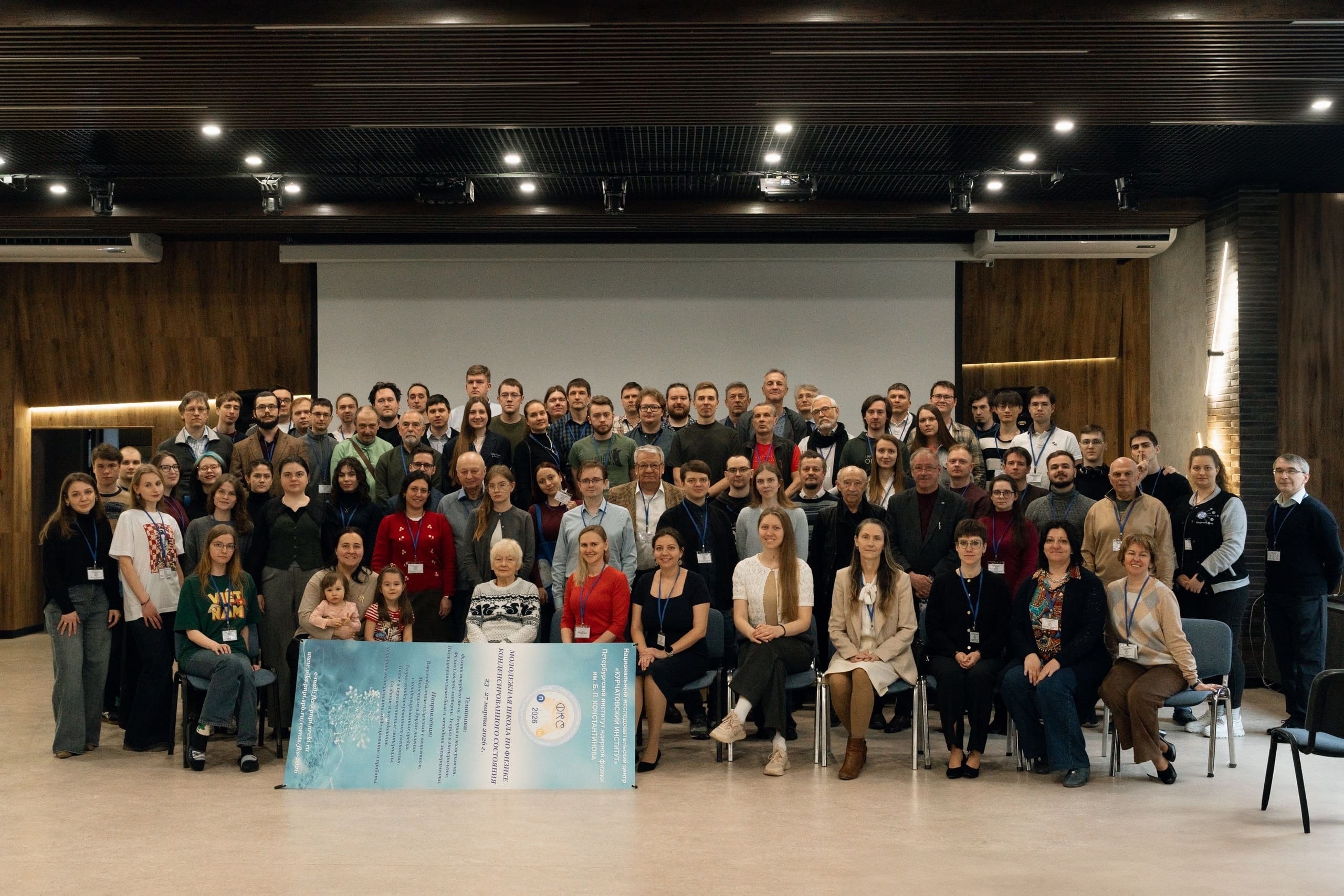
At the end of March, the town of Zelenogorsk hosted the School on Condensed Matter Physics (CMP-2026), organized by the National Research Center “Kurchatov Institute”, B.P.Konstantinov Petersburg Nuclear Physics Institute.
The school’s program revolved around three core thematic tracks: solid-state physics, soft matter physics (both theoretical and experimental aspects), and experimental methodology and instrumentation. Participants attended a series of lectures, engaged in poster sessions, and delivered short oral presentations—providing young scientists with a dynamic platform to share their research.
A highlight of the event was the “Enthusiasts’ Club” meetings, held across five specialized sections:
· Interaction of Radiation with Matter
· Magnetism and Other Phenomena in Condensed Media
· Theory of Condensed Matter
· Novel and Promising Materials (Design and Characterization)
· Experimental Techniques, Modeling, and Instrumentation
Plenary and parallel sessions featured compelling talks by leading researchers, including:
· Yu. M. Shukrinov (LTP, JINR, Dubna): “Modern Josephsonics: Directions and Prospects”
· R. Khanas (MIPT, Moscow): “Altermagnetism”
· M. V. Avdeev (JINR, Dubna): “Fixed Points in Small-Angle Scattering”
· E. I. Titova (MIPT, Dolgoprudny): “Graphene-Based Optoelectronics and Other 2D Materials: Scotch Tape vs. CVD”
Representing Samara University, two master’s students from the Department of General and Theoretical Physics actively contributed to the school:
Artem A. Bokarev presented a poster titled “Theoretical Prediction of Novel sp³ Carbon Structures Based on Zeolite Frameworks Using the Triply Periodic Surfaces (TPS) Generation Method” (Supervisor: A. A. Kabanov, Candidate of Physical and Mathematical Sciences, Associate Professor).
His work outlined a multi-stage computational approach to predicting new carbon allotropes: generating TPS models from zeolite frameworks, constructing hypothetical carbon networks, and validating their stability via Density Functional Theory (DFT) and Molecular Dynamics (MD) simulations. The study successfully identified 19 new sp³ carbon allotropes, calculated their elastic properties, and compared results obtained through DFT and MD methods.
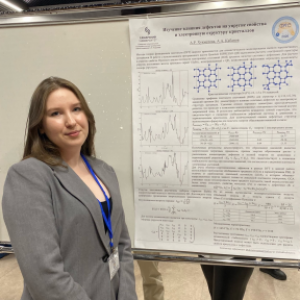
Anna R. Khukmatova also participated with a poster presentation “Investigating the Impact of Defects on the Elastic Properties and Electronic Structure of Crystals.”
Her research employed Density Functional Theory (DFT) to compute the electronic density of states in defective silicon crystals. Additionally, she derived elastic stiffness matrices using the ElaStic computational toolkit, offering insights into how structural imperfections influence mechanical and electronic behavior in semiconductors.
