

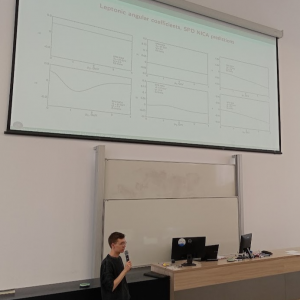
Scientists from Samara University—Alexandra Shipilova, Associate Professor at the Department of General and Theoretical Physics, and Kirill Shilyaev, a PhD student in the same department—recently participated in the 11th meeting of the international SPD NICA collaboration. Held from May 18 to 22, 2026, at Tomsk State University, the event brought together over 170 scientists and engineers from Russia, Armenia, China, Belarus, South Africa, and Cuba. They gathered to discuss the latest updates on the SPD project, the progress of the experimental setup, and the development of the IT infrastructure for the upcoming spin physics experiment at the NICA collider at the Joint Institute for Nuclear Research (JINR).
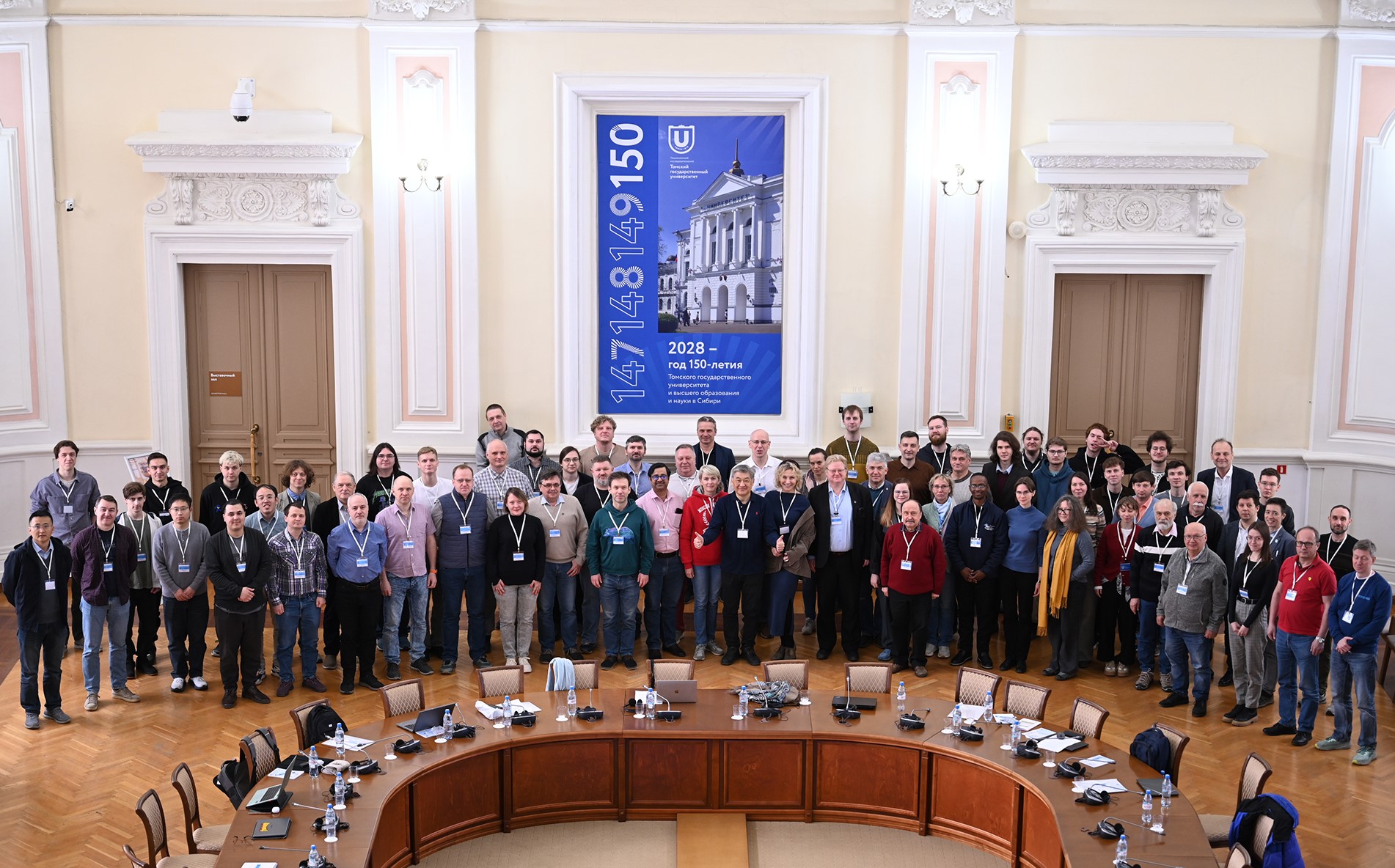
Opening the meeting, Tomsk State University Rector Eduard Galazhinsky emphasized the vital role of international scientific events in fostering new ideas and strengthening professional ties, which serve as the driving force behind scientific progress. Representatives from various leading research centers, including TSU, the Petersburg Nuclear Physics Institute (PNPI), and JINR, delivered presentations. Special attention was given to the development of experimental infrastructure, particularly the technical preparation of the Spin Physics Detector (SPD) for the NICA accelerator complex and the creation of a data acquisition system. Engineers have successfully completed the initial phases of the collider's commissioning and are now working to boost its efficiency. In the near future, contracts will be signed for new magnet yoke components, which will be manufactured in Syzran, Samara Region. The scientific program featured over 60 presentations covering key aspects of the experiment's development. Young scientists and students also had the opportunity to showcase their ideas in a student presentation contest, while participants discussed organizational matters, collaboration expansion, and preparations for upcoming international seminars. The event underscored the active development of international cooperation in fundamental physics and the continuous enhancement of the experimental base for exploring the micro-world.
Samara University’s Contribution to Fundamental Physics
Samara University has been an official member of the SPD NICA collaboration since 2021. The university's scientific group within the collaboration includes Professor Vladimir Saleev, Associate Professors Anton Karpishkov and Alexandra Shipilova, Head of the Telecommunications Center Alexander Baskakov, and PhD students Lev Alimov and Kirill Shilyaev.
During the meeting, Alexandra Shipilova delivered a talk titled "Large-pT photon production at SPD NICA beyond the LO QCD," while Kirill Shilyaev presented "Polarized J/psi production and gluon TMD PDFs in a proton."
The Samara scientists' presentations featured theoretical predictions for some of the most crucial processes for studying proton spin and the gluon distribution function within the proton: the production of hidden charm and direct photons, which will be extensively studied by the SPD collaboration. Over the past year, the Samara SPD group has published seven scientific papers and delivered eight presentations at various conferences dedicated to the SPD NICA project. Physics students have also been actively involved, preparing five thesis projects directly focused on future SPD NICA experiments.
Powering the Experiment with Advanced Computing
In his report, the SPD NICA software coordinator specially highlighted the Samara group's contribution to the development of the distributed data processing system. This includes active collaborative work with Samara University's computing cluster, launched in the summer of 2025, which handles remote calculations, simulations, and data processing within the SPD NICA GRID system. Samara University's computing center, alongside those of JINR and St. Petersburg, is one of the four largest nodes in the experiment's distributed IT infrastructure.
A New Era of Cooperation with JINR
Samara University's cooperation with JINR extends far beyond high-energy physics and IT. Just last week in Dubna, a crucial cooperation agreement was signed between Samara University and JINR. The document formalizes the commitment of both parties to develop joint scientific projects, educational programs, and international ties in nuclear sciences, particle physics, and science popularization.
A special emphasis is placed on establishing a JINR Information Center at Samara University, which will become a new hub for scientific and educational exchange, as well as a center for career guidance to help local schoolchildren choose scientific careers in physics. A "roadmap" for joint initiatives is already being drafted, encompassing internships, guest lectures, and joint research across a wide range of fields, including high-energy physics, nuclear physics, condensed matter physics, biophysics, and information technology.
For Reference:
The SPD (Spin Physics Detector) experiment at the NICA (Nuclotron-based Ion Collider fAcility) in Dubna, Moscow Region, is designed to study the spin characteristics of elementary particles. The collider will collide beams of polarized protons and deuterons at center-of-mass energies up to 13.5 GeV. The experiment aims to investigate the quark-gluon structure of protons and deuterons, specifically the nature and properties of their intrinsic quantum angular momentum—spin.
Pictured: Alexey Guskov, Co-Head of the SPD NICA Collaboration, Doctor of Physical and Mathematical Sciences; Alexandra Shipilova, Associate Professor at the Department of General and Theoretical Physics, Candidate of Physical and Mathematical Sciences; and Kirill Shilyaev, PhD student at the Department of General and Theoretical Physics.
